Volume: 13 Issue: 3 November 2015 - Supplement - 3
FULL TEXT
We present a rare case of progressive familial intrahepatic cholestasis within a family. A 34-year-old female became a living-related liver transplant donor for her son, who had the disease. Nine years after the transplant, the mother developed severe intrahepatic cholestasis, for which she was evaluated after using an oral contraceptive drug. She presented with jaundice, pruritus, and increased bilirubin levels, together with elevated gamma glutamyl transferase and alkaline phosphatase levels. A liver biopsy revealed findings consistent with intrahepatic cholestasis. However, despite follow-up management and cessation of the insulting drug, her total bilirubin count continuously increased to 20 mg/dL and was accompanied by intractable pruritus. A total of 9 plasmapheresis sessions were performed, and she was started on a regimen of ursodeoxycholic acid (13 mg/kg/d) and cholestyramine (4 g, 3 times daily). The clinical and laboratory picture dramatically improved following cessation of the oral contraceptive, plasmapheresis sessions, and drug treatment. The patient’s cholestasis normalized within 3 months, and she recovered uneventfully.
A genetic analysis of the whole family revealed that both parents were heterozygous for the mutation c.124G>A in ABCB11, and the son was homozygous for this mutation. These findings supported varying degrees of bile salt export pump deficiency in the family members. Defective bile salt excretory system function can result in a wide spectrum of clinical presentations, ranging from progressive familial intrahepatic cholestasis requiring liver transplant to late-onset drug-induced cholestasis. Our findings suggest that, in a heterozygous carrier of a progressive familial intrahepatic cholestasis mutation, drug-induced cholestasis is responsive to treatment, after which the clinical picture can normalize within 3 months.
Key words : Living-donor liver transplant, Oral contraceptives, Drug-induced cholestasis
Introduction
Progressive familial intrahepatic cholestasis (PFIC) type 2 is caused by several mutations in the ABCB11 gene encoding for the bile salt export protein (BSEP). Definitive treatment consists of liver transplant during childhood, which is most commonly performed using a liver donation obtained from a parent. After living donor liver transplant, several problems can arise, such as alloimmunization by autoantibodies against “new” exporter proteins expressed in the transplanted liver,1,2 and theoretically, recurrence of the disease owing to defective parental proteins.3,4 Although the complications that can arise in the recipient are fairly well known, the literature lacks information about possible clinical problems that can occur in the donor. In this report, we present a rare case of PFIC in a living-related donor after transplant. The mother, who was a living-related liver transplant donor to her son who had developed PFIC, developed severe drug-induced cholestasis 9 years after the transplant.
Case Report
A 34-year-old woman, who was a living-related liver transplant donor to her son 9 years previously, presented with acute onset of pruritus and icterus. The laboratory found mildly increased liver enzymes compatible with cholestasis. Liver ultrasonography was normal. Upon further investigation for liver disease, the results for hepatitis markers, autoimmune markers, iron indices, and copper studies were within normal limits. The patient had a history of recent oral contraceptive use for contraception. Her medical history revealed a history of severe cholestasis while pregnant with her son, who would later develop PFIC, and for whom she would be a liver donor.
Despite cessation of the oral contraceptive and expectantly managing her case for 4 weeks, her bilirubin levels gradually rose, peaking at 20 mg/dL. A liver biopsy was performed and revealed findings consistent with intrahepatic cholestasis. A total of 9 plasmapheresis sessions were performed, and the patient was started on combined therapy with ursodeoxycholic acid (13 mg/kg/d) and cholestyramine (4 g, 3 times daily). A rapid improvement in her condition was observed, and all the laboratory test results normalized after 3 months of plasmapheresis and drug therapy (Figure 1).
Later, we performed a genetic analysis of the whole family. This analysis showed that both parents were heterozygous for the mutation c.124G>A in the ABCB11 gene and that their son was homozygous for the same mutation. These findings supported varying degrees of BSEP deficiency in the family members.
Discussion
Intrahepatic cholestasis caused by several mutations responsible for defects in the bile canalicular pump system is known as PFIC (formerly known as Byler disease). A spectrum of autosomal recessive inheritance traits results in 3 major types of PFIC. The major defect in PFIC type 2 is related to BSEP malfunction at the canaliculus membrane of hepatocytes, leading to an accumulation of bile salts. In PFIC type 2, genetic mutations can result in either defective protein function, in which immune staining is positive for the protein, or an absent protein, in which immune staining fails to identify the protein at the canaliculus membrane. Therefore, the presence of several mutations results in a variety of clinical presentations, including benign recurrent intrahepatic cholestasis type 2, intrahepatic cholestasis of pregnancy, and drug-induced cholestasis.5 In addition, the association of drug-induced cholestasis with BSEP mutations is well known; thus, if a person harbors a heterozygous mutation (is a carrier, as in our case), or a polymorphism is present, then the possibility of developing severe cholestasis increases 3-fold.5
When it presents in its purest form, drug-induced cholestasis is rapidly reversible, as was clearly shown by Fattinger and associates.6 However, cholestasis may leave residual effects; for example, mitochondrial function might be inhibited secondarily after accumulation of bile acids in the intracellular space.7,8 In turn, malfunctioning mitochondria produce less adenosine triphosphate, which in turn further impairs adenosine triphosphate–dependent BSEP functions.9 Therefore, drug-induced and/or bile acid–induced dual inhibition of mitochondrial and BSEP functions might result in prolonged and severe drug-induced cholestasis, as in the case presented here.10 Although rapid reversal of liver cholestasis after cessation of the insulting drug is expected in the simple form of drug-related BSEP malfunction, severe and prolonged cholestasis requiring medical intervention (as presented in our case) can be theoretically explained by this dual-inhibition mechanism.
Although using hormonal contraception after an incidence of intrahepatic cholestasis in pregnancy is reported to be safe,11 to our knowledge, oral contraceptive–related cholestasis due to a BSEP mutation has not been reported before. The safety of liver donation for parents in PFIC-related cases has been deemed acceptable in an era of living donor shortage. In a published cohort study, Cutillo and associates concluded that transplant does not increase liver dysfunction in donors, regardless of their heterozygous status for PFIC mutations.1 However, in their cohort, only 2 out of 7 donors were women, and these mothers had no history of intrahepatic cholestasis of pregnancy that might be associated with a lower degree of protein malfunction or a milder degree of protein deficiency. Based on our case report, we emphasize that although living-donor liver transplant is accepted as safe for both recipients and donors, donors must be aware of the risk of drug-induced cholestasis, especially with oral contraceptive use.
Conclusions
Defective bile salt excretory system function results in a wide spectrum of clinical presentations, ranging from PFIC requiring liver transplant to late-onset clinical disease, as in drug-induced cholestasis. Our case was unique in that it showed that severe cholestasis can develop in donors who are heterozygous for PFIC mutations, especially after a trigger event such as drug-induced liver injury. Our findings also suggest that drug-induced cholestasis in a carrier of heterozygous PFIC mutations is completely responsive to medical treatment, after which the clinical picture can normalize over a course of 3 months.
References:
- Cutillo L, Najimi M, Smets F, et al. Safety of living-related liver
transplantation for progressive familial intrahepatic cholestasis. Pediatr
Transplant. 2006;10(5):570-574.
CrossRef - PubMed - Soubrane O, Gauthier F, DeVictor D, et al. Orthotopic liver
transplantation for Byler disease. Transplantation. 1990;50(5):804-806.
CrossRef - PubMed - Davit-Spraul A, Gonzales E, Baussan C, Jacquemin E. Progressive familial
intrahepatic cholestasis. Orphanet J Rare Dis. 2009;4:1.
CrossRef - PubMed - Maggiore G, Gonzales E, Sciveres M, et al. Relapsing features of bile
salt export pump deficiency after liver transplantation in two patients with
progressive familial intrahepatic cholestasis type 2. J Hepatol.
2010;53(5):981-986.
CrossRef - PubMed - Lang C, Meier Y, Stieger B, et al. Mutations and polymorphisms in the
bile salt export pump and the multidrug resistance protein 3 associated with
drug-induced liver injury. Pharmacogenet Genomics. 2007;17(1):47-60.
CrossRef - PubMed - Fattinger K, Funk C, Pantze M, et al. The endothelin antagonist bosentan
inhibits the canalicular bile salt export pump: a potential mechanism for
hepatic adverse reactions. Clin Pharmacol Ther. 2001;69(4):223-231.
CrossRef - PubMed - Lee JK, Marion TL, Abe K, Lim C, Pollock GM, Brouwer KL. Hepatobiliary
disposition of troglitazone and metabolites in rat and human
sandwich-cultured hepatocytes: use of Monte Carlo simulations to assess the
impact of changes in biliary excretion on troglitazone sulfate accumulation.
J Pharmacol Exp Ther. 2010;332(1):26-34.
CrossRef - PubMed - Krähenbühl S, Talos C, Fischer S, Reichen J. Toxicity of bile acids on
the electron transport chain of isolated rat liver mitochondria. Hepatology.
1994;19(2):471-479.
CrossRef - PubMed - Kostrubsky SE, Strom SC, Kalgutkar AS, et al. Inhibition of
hepatobiliary transport as a predictive method for clinical hepatotoxicity
of nefazodone. Toxicol Sci. 2006;90(2):451-459.
CrossRef - PubMed - Aleo MD, Luo Y, Swiss R, Bonin PD, Potter DM, Will Y. Human drug-induced
liver injury severity is highly associated with dual inhibition of liver
mitochondrial function and bile salt export pump. Hepatology.
2014;60(3):1015-1022.
CrossRef - PubMed - Kascák P, Korbel M. Hormonal contraception after intrahepatic
cholestasis of pregnancy. Ceska Gynekol. 2011;76(5):374-378.
PubMed

Volume : 13
Issue : 3
Pages : 107 - 109
DOI : 10.6002/ect.tdtd2015.P62
From the Departments of 1Gastroenterology, 2Pediatric
Gastroenterology, 3Pathology, and 4General Surgery,
Baþkent University Faculty of Medicine, Ankara, Turkey
Acknowledgements: The authors declare that they have no sources of
funding for this study and no conflicts of interest to report.
Corresponding author: Özgür Harmancý, Department of Gastroenterology,
Baþkent University Faculty of Medicine, Fevzi Çakmak Caddesi, 5. Sokak,
Poliklinik binasý, Gastroenteroloji Polikliniði, Bahçelievler, Çankaya, Ankara,
Turkey
Phone: +90 312 203 6868
Fax: +90 312 223 6439
E-mail: ozgurharmanci@gmail.com
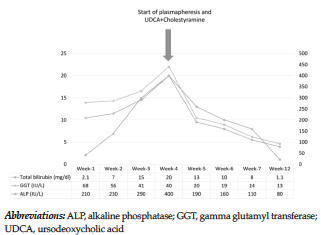
Figure 1. Changes in Laboratory Values During Follow-Up For Progressive Familial Intrahepatic Cholestasis