Volume: 14 Issue: 3 June 2016
FULL TEXT
Chylous ascites is a rare complication in liver transplant. Few cases have been reported to date. In most cases, chylous ascites is diagnosed within 1 month after surgery because of intraoperative injury of the hilar lymphatic system. Preoperative massive ascites and use of a LigaSure vessel sealing system for hilar dissection have been reported as risk factors.
We report a case of chylous ascites after a living-donor liver transplant
that was diagnosed after 6 months of uneventful follow-up. Sirolimus was added
to cyclosporine early (2 wk after the operation) owing to poor renal function
and it was found to be high (> 22 ng/mL) when the chylous ascites occurred. The
patient was treated with
total parenteral nutrition in combination with Sandostatin and rapid tapering of
sirolimus after the failed initial conservative treatment. Residual abdominal
fullness after meals and lymphedema of the legs disappeared 1 month after
discontinuing sirolimus. This is the first case of delayed-onset chylous ascites
after a liver transplant that was successfully treated conservatively.
Key words : Delayed onset chylous ascites, Living-donor liver transplant, Preoperative massive ascites, LigaSure vascular sealing system
Introduction
Chylous ascites is a rare complication of liver transplant. To our knowledge, there are only 11 articles including 10 case reports1-9 (Table 1) and 1 retrospective case series study including 24 cases.10 In most of these cases, chylous ascites is diagnosed within 1 month after surgery. In only 1 case, the complication was diagnosed 9 months after liver transplant,1 and the patient failed to respond to a low-fat diet containing medium chain triglycerides but was treated successfully with a peritoneal venous shunt. Preoperative massive ascites, a low albumin level, and use of a LigaSure vessel sealing system (LVSS) (Covidien; Mansfield, MA, USA) for hilar dissection were associated with higher incidence in the Yilmaz study (4.7% vs 0.6%-1.6%).10
Case Report
This 56-year-old man, with hepatitis C virus (HCV) and alcoholic-related end-stage liver disease, underwent a living-donor liver transplant on July 31, 2012. His 27-year-old daughter donated the right lobe liver with a reconstructed middle hepatic vein weighing 615 grams, and the graft-to-recipient weight ratio was 1.18%. No significant dilated lymphatics or leakage of chylous fluid owing to injury of the cisterna chili occurred during the operation. We used anti-CD 25 (basiliximab) for induction therapy, and a calcineurin inhibitor (cyclosporine), steroids, and mycophenolate acid as maintenance immunosuppression. Sirolimus was added to reduce the cyclosporine dosage early (2 wk after surgery) owing to poor renal function. During the first 3 months, the sirolimus level remained at 8 to 15 ng/mL and cyclosporine level remained low (60-100 ng/mL). The patient’s postoperative course was uneventful, and he was discharged at postoperative day 32 without any chylous discharge from the subhepatic drain. Until the sixth postoperative month, no accumulation of free fluid was noted by routine monthly abdominal sonography.
About 6 months after transplant, his abdomen became distended, and
periumbilical pain that radiated to his back (associated with bilateral lower
limb numbness) was aggravated by lying on his back. His sirolimus level was
high, with the
trough level of about 22.4 ng/mL. Abdominal sonography showed new-onset ascites,
and chylous ascites was proven by laparoscopic examination to rule out
peritoneal carcinomatosis and the presence of elevated ascites triglyceride
concentration (5.09, mmol/L; normal, 1.8 mmol/L). No definite finding was
obtained by cytology, culture, and thoracoabdominal computed tomography. He was
treated with total parenteral nutrition for about 1 month combined with
octreotide acetate for injectable suspension (Sandostatin) (2 wk), after the
initial failure of conservative treatment. His sirolimus dosage also was reduced
from 1 mg daily to 1 mg every other day, to lower the serum level to 3 to 5
ng/mL. The chylous ascites gradually decreased in volume and changed to serous
ascites during the latter part of the clinical course and remitted uneventfully.
Residual abdominal fullness, especially after meals and left leg lymphedema,
disappeared 1 month after we stopped sirolimus during outpatient follow-up. The
patient's hospital course is summarized in Figure 1.
Discussion
Chylous ascites after liver transplant is commonly diagnosed within 1 month after surgery.1-10 This is the first case of delayed-onset chylous ascites after liver transplant successfully managed conservatively. Chylous ascites developed about 6 months after a living-donor liver transplant. A case diagnosed 9 months after a liver transplant1 was reported before, but failed to respond to conservative treatment and needed a peritoneal venous shunt. Our patient, however, was successfully treated conservatively with total parenteral nutrition, octreotide, and rapid tapering of mammalian target of rapamycin inhibitor, sirolimus.
Preoperative massive ascites, a low albumin level, and use of the LVSS for hilar dissection may be a fundamental cause for this patient.10 Because our case had a severely tense abdomen, a link to massive ascites with respiratory difficulty and poor intake, he received repeated paracentesis (biweekly) to relieve symptoms and frequent supplements of intravenous albumin infusion.
We also used LVSS, apart from ligation for hemostasis, during total hepatectomy in the recipient. Therefore, we cannot completely rule out this surgical method as an important cause of chylous ascites in our patient, although we did not realize any intraoperative and immediate or early postoperative chylous leak. Dislodge or absorption of covering blood clots or coagulated tissue from temporary and inadequately healed area of injured lymphatic system was probably due to using the LVSS for hemostasis.
Another factor to consider is the use of sirolimus for such high-risk patients. Some studies have shown that mammalian target of rapamycin inhibitor is a downstream signal of vascular endothelial growth factor C and D, which are essential for lymphatic endothelial cell survival, proliferation, and migration, and that mammalian target of rapamycin inhibitor such as sirolimus can inhibit lymphangio-genesis in vitro.11,12
Chylous ascites and lymphedema in a renal transplant case were attributed to 19-month use of mammalian target of rapamycin inhibitor (eg. sirolimus), and they were relieved 1 month after switching to cyclosporine.13 Interestingly, all these reported sirolimus-related cases (including ours) were diagnosed after at least 3 months use of sirolimus.14-17 Therefore, early use of sirolimus in our case should not be neglected as a possible cause of delayed-onset chylous ascites.
Once chylous ascites is diagnosed, most patients can be treated successfully with conservative measures; few cases require surgery. However, the first patient with delayed-onset chylous ascites reported in literature had to undergo surgical intervention. Here, we share our experience of successful conservative treatment for this entity. The cause of chylous ascites after a liver transplant should be multifactorial, and all possible risk factors should be carefully considered, and a multidisciplinary approach is necessary for excellent results.
In conclusion, chylous ascites is a rare complication after liver transplant. Most reported cases are diagnosed within 1 postoperative month. Preoperative poorly controlled ascites or application of the LVSS during dissection, especially in hilar region, increase the risk of postoperative chylous ascites. Sirolimus also should be carefully used or avoided, especially in the early posttransplant days in high-risk patients. The cause of chylous ascites after a liver transplant should be multifactorial, and all possible risk factors should be considered and a multidisciplinary approach is necessary for excellent results.
References:
- Saab S, Nguyen S, Collins J, Kunder G, Busuttil RW. Lymphedema tarda
after liver transplantation: a case report and review of the literature. Exp
Clin Transplant. 2006;4(2):567-570.
CrossRef - PubMed - Baran M, Cakir M, Yüksekkaya HA, et al. Chylous ascites after living
related liver transplantation treated with somatostatin analog and
parenteral nutrition. Transplant Proc. 2008;40(1):320-321. doi:
10.1016/j.transproceed.2007.11.056.
CrossRef - PubMed - Ijichi H, Soejima Y, Taketomi A, et al. Successful management of chylous
ascites after living donor liver transplantation with somatostatin. Liver
Int. 2008;28(1):143-145. doi: 10.1111/j.1478-3231.2007.01556.x.
CrossRef - PubMed - Asfar S, Lowndes R, Wall WJ. Chylous ascites after liver
transplantation. Transplantation. 1994;58(3):368-369.
CrossRef - PubMed - Shapiro AM, Bain VG, Sigalet DL, Kneteman NM. Rapid resolution of
chylous ascites after liver transplantation using somatostatin analog and
total parenteral nutrition. Transplantation. 1996;61(9):1410-1411.
CrossRef - PubMed - Haberal M, Karakayali H, Moray G, Bilgin N. Surgical treatment of
chylous ascites following partial living-related liver transplantation.
Transpl Int. 1998;11(4):327-328.
CrossRef - PubMed - Senyüz OF, Sentürk H, Taşçi H, Kaya G, Ozbay G, Sariyar M. Chylous
ascites after liver transplantation with mesentero-portal jump graft. J
Hepatobiliary Pancreat Surg. 2001;8(6):571-572.
CrossRef - PubMed - Shiba H, Wakiyama S, Gocho T, Ishida Y, Misawa T, Yanaga K. A case of
successful conservative treatment for chylous ascites after living-donor
liver transplantation. Int Surg. 2012;97(4):360-362. doi: 10.9738/CC118.1.
CrossRef - PubMed - Mukerji AN, Tseng E, Karachristos A, Maloo M, Jain A. Chylous ascites
after liver transplant: case report and review of literature. Exp Clin
Transplant. 2013;11(4):367-374. doi: 10.6002/ect.2012.0203.
CrossRef - PubMed - Yilmaz M, Akbulut S, Isik B, et al. Chylous ascites after liver
transplantation: incidence and risk factors. Liver Transpl.
2012;18(9):1046-1052. doi: 10.1002/lt.23476.
CrossRef - PubMed - Kobayashi S, Kishimoto T, Kamata S, Otsuka M, Miyazaki M, Ishikura H.
Rapamycin, a specific inhibitor of the mammalian target of rapamycin,
suppresses lymphangiogenesis and lymphatic metastasis. Cancer Sci.
2007;98(5):726-733.
CrossRef - PubMed - Huber S, Bruns CJ, Schmid G, et al. Inhibition of the mammalian target
of rapamycin impedes lymphangiogenesis. Kidney Int. 2007;71(8):771-777.
CrossRef - PubMed - Castro G, Freitas C, Beirão I, Rocha G, Henriques AC, Cabrita A. Chylous
ascites in a renal transplant recipient under sirolimus (rapamycin)
treatment. Transplant Proc. 2008;40(5):1756-1758. doi:
10.1016/j.transproceed.2008.02.074.
CrossRef - PubMed - van Onna M, Geerts A, Van Vlierberghe H, et al. One-sided limb
lymphedema in a liver transplant recipient receiving sirolimus. Acta
Gastroenterol Belg. 2007;70(4):357-359.
PubMed - Al-Otaibi T, Ahamed N, Nampoory MR, et al. Lymphedema: an unusual
complication of sirolimus therapy. Transplant Proc. 2007;39(4):1207-1210.
CrossRef - PubMed - De Bartolomeis C, Collini A, Rumberger B, et al. Generalized lymphedema
in a sirolimus-treated renal transplant patient. Clin Transplant.
2008;22(2):254-257. doi: 10.1111/j.1399-0012.2007.00766.x.
CrossRef - PubMed - Desai N, Heenan S, Mortimer PS. Sirolimus-associated lymphoedema: eight
new cases and a proposed mechanism. Br J Dermatol. 2009;160(6):1322-1326.
doi: 10.1111/j.1365-2133.2009.09098.x.
CrossRef - PubMed

Volume : 14
Issue : 3
Pages : 345 - 348
DOI : 10.6002/ect.2014.0131
From the 1Department of General Surgery; the 2Department
of Rheumatology, Dalin Tzu Chi General Hospital, Chia-I, Taiwan; and the 3Department
of Medicine, Tzu Chi University, Hualien, Taiwan
Acknowledgements: The authors have no conflicts of interest to disclose,
and there was no funding for this study.
Corresponding author: Wen-Yao Yin, MD, FACS, Department of General
Surgery, Dalin Tzu Chi General Hospital, Chiay-I, Taiwan, No. 2, Minsheng Rd.,
Dalin Township, Chia -I, 622, Taiwan (R.O.C.)
Phone: +93 270 6392
Phone: +886 5 264 8006
E-mail: wenyao4748@gmail.com
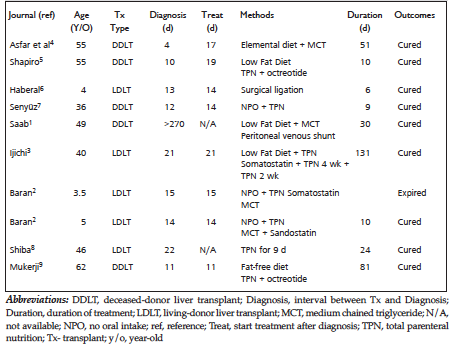
Table 1. Previous Cases Report in Literature
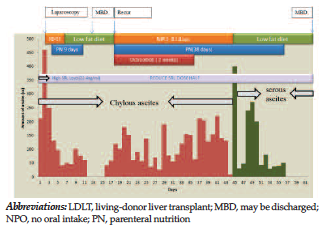
Figure 1. Clinical Course of the Patient With Chylous Ascites 6 Months After Living-Donor Liver Transplant